
Does your website meet the U.S. ADA accessibility compliance requirements? The volume of related lawsuits is projected to rise by 40% in 2025,and the compliance deadlines for the new Title II rule are approaching — April 2026 for large entities and April 2027 for smaller organizations. If any website operated by a U.S. institution or business fails to meet compliance standards, its owner will face severe legal and financial risks. We have launched an exclusive compliance guide that uses plain language and actionable steps to break down the fundamentals of compliance across three core modules. The guide covers a full scope of content including ADA compliance services, WCAG 2.2 audits, and lawsuit avoidance strategies for all types of organizations.
The Definition and Importance of ADA Website Compliance
The first module organizes the definition and importance of ADA website compliance, citing core requirements of the U.S. ADA Act that ban disability discrimination in all public life scenarios, including websites. U.S. courts have consistently ruled that websites qualify as “places of public accommodation” under the ADA Title III framework, requiring them to be open to all users. Compliance is a mandatory requirement that applies to all entities, including education providers, government bodies, healthcare institutions, and businesses across all categories.
Industry statistics show that the U.S. has a large population of disabled adults, ADA website lawsuits have risen year after year, the cost of a single lawsuit is extremely high, the current WCAG adaptation rate of mainstream websites is very low, and an acute compliance crisis is emerging.
The ADA Title II Compliance Deadlines Explained
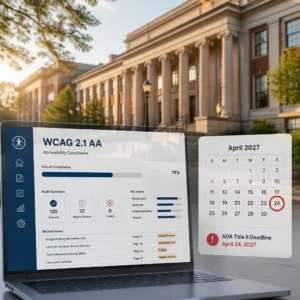
The second module explains the ADA Title II compliance deadlines: citing the new Title II rules released by the U.S. Department of Justice (DOJ) in April 2024, which require state and local governments’ websites and mobile applications to meet WCAG 2.2, with two separate deadlines set for different groups:
| Entity Type | Population Served | Compliance Deadline |
|---|---|---|
| Large entities | Over 50,000 | April 2026 |
| Small entities | Fewer than 50,000 | April 2027 |
Affected entities include public universities, community colleges, K-12 school districts, government websites at all levels, public hospitals, and judicial institution websites, among others. This guide recommends that eligible organizations hire professional ADA compliance services as soon as possible to begin rectification work ahead of their applicable deadline.
WCAG 2.2 — The Core Compliance Standard
The third module breaks down WCAG 2.2, the core compliance standard: this internationally recognized web accessibility standard, released in October 2023, is the reference baseline for the ADA, U.S. Section 508, and various global accessibility regulations. It is built on the four POUR principles:
| Principle | Key Requirements |
|---|---|
| Perceivable | Images must have alternative text; videos must include captions; color contrast must be no lower than 4.5:1; text must be scalable up to 200% without content loss |
| Operable | Full keyboard navigation support; no content that triggers seizures; sufficient reading time for users; clear focus states for interactive elements |
| Understandable | Consistent navigation; dedicated error prompts; explicit page language marked in code |
| Robust | Content must be compatible with all types of assistive technologies |
If your enterprise needs to meet U.S. web accessibility compliance requirements, you must first clarify the core basic technical requirements for web accessibility: your site must be compatible with leading screen reader tools including JAWS, NVDA, and VoiceOver.
However, the vast majority of enterprises with compliance needs confuse three core accessibility standards, so we will first clarify these rules for you, then provide a full-chain compliance solution.
The latest WCAG 2.2 adds 9 success criteria to the older WCAG 2.1 standard, and we have launched a supporting WCAG 2.2 to help enterprises quickly adapt to the new standard.
The Differences Between ADA, Section 508, and WCAG
The differences between ADA, Section 508, and WCAG are the most common cognitive pitfall that enterprises fall into:
| Standard | Scope | Applicability |
|---|---|---|
| ADA | Anti-discrimination compliance rule in U.S. civil and commercial domains | Applicable to all publicly operating commercial websites |
| Section 508 | Federal procurement standard | Applies only to the websites of suppliers that undertake federal government projects |
| WCAG | Technical benchmark | Referenced by both ADA and Section 508 enforcement requirements |
We have also launched a matching Section 508 compliance service to cover all use case compliance needs.
The True Cost of Non-Compliance
After analyzing thousands of ADA compliance demand letters, we found that non-compliance costs are far higher than most enterprises anticipate:
| Cost Category | Estimated Range |
|---|---|
| Responding to a single demand letter | $5,000 – $15,000 USD |
| Settlement fees | $15,000 – $75,000 USD |
| Trial costs | $50,000 – $250,000+ USD |
Enterprises also stand to lose access to 61 million potential customers with disabilities in the U.S., making investment in professional auditing extremely cost-effective. Just 10 types of high-frequency compliance flaws trigger 80% of all ADA lawsuits, including contrast ratio issues that can even be identified with a basic tool like WebAIM’s Contrast Checker.
We also provide accessibility remediation services for various document types including PDFs, to resolve all compliance risks through a one-stop solution.
Compliance Is Not a One-Time Task
Many clients mistakenly assume that achieving ADA website accessibility compliance is a one-time task, but this requirement actually demands long-term maintenance. Our team provides all clients with a standardized four-step implementation process:
| Step | Action | Details |
|---|---|---|
| 1. Accessibility Audit | Aligned with the WCAG 2.2 standard | Automated tools can only identify 30% of all compliance issues, while the remaining 70% require verification by professional human experts |
| 2. Compliance Remediation | Complete ARIA revisions, keyboard navigation adaptations, and screen reader optimizations | Technical fixes to bring your site into conformance |
| 3. Produce VPAT and ACR | Generate compliance documents | VPAT and ACR documentation for procurement and legal protection |
| 4. Continuous Monitoring | Use automated scanning to issue early warnings | Failure to address issues in a timely manner can trigger lawsuits |
Every step in the process comes with clear deliverables.
High-Risk Industries in 2026
According to the latest litigation trends report released by the U.S. Department of Justice (DOJ) and the Office for Civil Rights (OCR), ADA lawsuits targeting website accessibility compliance in 2026 will be highly concentrated across five high-risk industries. We have launched matched professional solutions to address the unique compliance pain points of each sector:
| Industry | Common Compliance Pain Point | Our Solution |
|---|---|---|
| E-commerce Retail | Product page incompatibility with screen readers | Tailored screen reader optimization |
| Education | Must meet dual requirements of WCAG 2.2 Level AA and Section 508 simultaneously | Integrated WCAG 2.2 and Section 508 compliance |
| Financial Services | Balancing compliance requirements and user data privacy standards | Privacy-first accessibility remediation |
| Healthcare | Must add the unique compliance rules of HIPAA | HIPAA-aware accessibility solutions |
| Government Public Agencies | Mandatory obligation to provide legally required accessible services | Full ADA compliance for public sector |
Every solution is precisely tailored to the regulatory details of its corresponding industry, and is never a generic one-size-fits-all template.
Why DIY Compliance Remediation Fails
Next, we will address the core question asked by most clients: why cannot we choose DIY compliance remediation? DIY remediation completed only with automated scanning tools such as Axe and WAVE has three fatal flaws:
- It can only identify around 30% of explicit accessibility issues, and cannot cover hidden compliance gaps such as screen reader compatibility and keyboard navigation logic.
- It cannot align with the unique regulatory requirements of each industry; for example, the add-on HIPAA rules for the healthcare sector are completely unidentifiable by generic scanning tools.
- It cannot issue a legally valid compliance certificate after remediation, so it cannot guard against potential litigation risks.
Five Core Client Questions Answered
To remove barriers to your decision-making, we have compiled and answered the five core questions that most clients raise during the decision-making process one by one:
- What is the full timeline for compliance remediation?
- What compliance standards are covered by the service?
- By what percentage can litigation risk be reduced after remediation?
- What are the accounting standards for service fees?
- What is included in subsequent annual compliance maintenance?
All answers are based on the official ADA regulatory requirements, to help you quickly complete your compliance deployment and reliably avoid the high litigation risk expected in 2026.
The Danger of Accessibility Overlay Tools
Since 2023, the number of relevant lawsuits filed against companies operating within the United States that use accessibility overlay tools has risen sharply, bringing a sudden steep increase in compliance pressure.
VPAT and ACR Documentation
The VPAT, short for Voluntary Product Accessibility Template, is a document used to record a product’s compliance with accessibility standards, and it is a common requirement for procurement by U.S. federal contractors and educational institutions. Our organization, Access Level Up, can generate fully compliant ACR reports, and also provides free website accessibility assessments.
Our team will issue a free initial discovery report to help you clarify all relevant risks. Our full suite of compliance services, including ADA compliance reviews and WCAG 2.2 audits, covers all types of U.S.-based enterprises, educational institutions, government agencies, and digital product organizations.